


2026 Honda HR-V vs. Corolla Cross vs Venue vs Outlander Sport
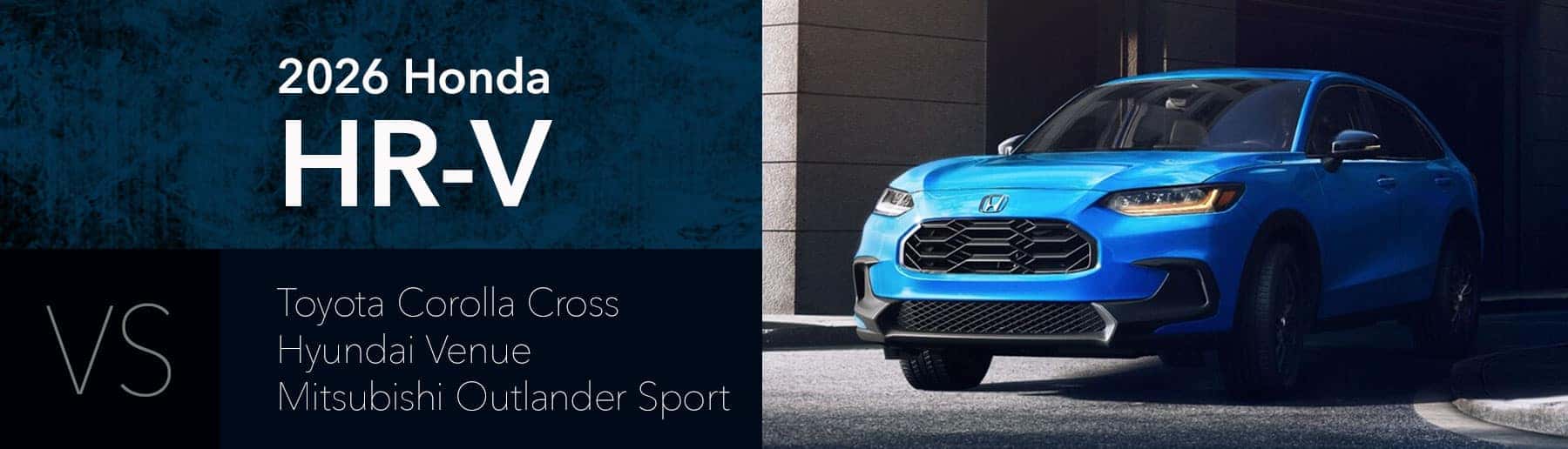
Compact SUVs have become a popular segment, and one of the most popular is the Honda HR-V. This attractive and practical vehicle has a lot to offer, but in such a popular segment, it obviously has competitors. How do these measure up to the HR-V? Germain Honda of Surprise has put together this helpful guide to show what the competition has to offer.
Honda HR-V vs Toyota Corolla Cross
 |
 |
|
| 2026 Honda HR-V EX-L FWD | VS | 2025 Toyota Corolla Cross LE FWD |
| $30,050 | MSRP (excluding destination charges)* | $26,465 |
| 37.7 inches ✓ | Back Seat Legroom | 32 inches |
| 9 inches ✓ | Infotainment Touchscreen Size | 8 inches |
| 8 ✓ | Speakers | 6 |
| Leather ✓ | Seat Material | Cloth |
| Power adjustable ✓ | Driver’s Seat | Manually adjustable |
| Digital, customizable ✓ | Gauges | Analog |
| Standard ✓ | Heated Front Seats | Requires Higher Trim |
| Standard ✓ | Power Moonroof | Requires Higher Trim |
| Standard ✓ | Active Noise Cancellation | Not Available |
First up against the Honda HR-V is a relative newcomer, the Toyota Corolla Cross. The Corolla Cross has a low starting price but it increases sharply as you move up to higher trims. As a result, we’re comparing the similarly priced HR-V EX-L and the LE trim for the Corolla Cross. No matter how much you spend on a Corolla Cross, you’ll notice right away that the back seat is tiny. The hip and shoulder room is noticeably less than on the HR-V while its rear legroom measurements are where the Corolla Cross back seat seems not even usable by adults. On top of that, they’re cloth seats compared to the leather you get with the HR-V. The HR-V also comes with a 10-way power-adjustable driver’s seat with heating functions while Corolla Cross drivers will have to settle for one that is manually adjustable.
The HR-V EX-L trim comes with the premium stereo and a 9-inch infotainment screen. You won’t get that in the Corolla Cross which comes with a smaller screen and fewer speakers. The HR-V also comes with a customizable digital gauge cluster and active noise cancellation, both things you’ll need to move up to a higher trim to get in the Corolla Cross. Lastly, a major advantage that comes from choosing the HR-V over the Corolla Cross is its impressive one-touch power moonroof.
Honda HR-V vs Hyundai Venue
 |
 |
|
| 2026 Honda HR-V LX FWD | VS | 2025 Hyundai Venue Limited FWD |
| $26,200 | MSRP (excluding destination charges)* | $23,450 |
| 158 HP / 138 LB-FT TQ ✓ | Horsepower / Torque | 121 HP / 113 LB-FT TQ |
| 98.7 cubic feet ✓ | Total Passenger Volume | 91.9 cubic feet |
| 24.4 cubic feet ✓ | Cargo Space (behind back seats) | 18.7 cubic feet |
| 14 gallons ✓ | Fuel Tank | 11.9 gallons |
| Multi-link ✓ | Rear Suspension | Torsion beam |
| Multi-angle ✓ | Backup Camera | Single-angle |
| Wireless ✓ | Android Auto / Apple CarPlay | Wired |
| Standard ✓ | Digital Gauge Cluster | Not Available |
| Standard ✓ | Traffic Jam Assist | Not Available |
Up next, we look at how the Honda HR-V measures up to the smallest SUV in the Hyundai model lineup – the Venue. It has an unusually low starting price which is seen as an advantage. A low price isn’t always a good deal and to illustrate this, we’re comparing the top Limited trim of the Venue to the base LX trim of the HR-V. From the start, we can see that the Venue is down on power compared to the HR-V. It is a smaller vehicle but not by enough that you won’t have some difficulty passing or getting up to highway speeds. The HR-V is clearly bigger, both for passengers and cargo, and even the fuel tank is noticeably bigger. Since fuel economy numbers are similar, a full tank will get you an additional 19 miles of city driving in the HR-V and 50 miles on the highway.
Since we’re comparing a top-spec model to a base model, you’re probably expecting the Venue to mop up in the equipment department. You’d again be mistaken. For starters, the Venue uses a torsion beam rear suspension which gives the Venue a bit more sorely needed cargo space. This comes at the sacrifice of good handling. The HR-V doesn’t need to make such a compromise and delivers both excellent handling and incredible cargo space. Finally, a good deal of the technology that comes standard on the HR-V isn’t available on even the highest trim of the Venue. This includes a multi-angle backup camera, wireless Android Auto/Apple CarPlay, a digital instrument cluster, and Traffic Jam Assist.
Honda HR-V vs Mitsubishi Outlander Sport
|
 |
|
| 2026 Honda HR-V LX AWD | VS | 2025 Mitsubishi Outlander Sport ES AWD |
| $26,200 | MSRP (excluding destination charges)* | $25,745 |
| 158 ✓ | Horsepower | 148 |
| 25 / 30 / 27 ✓ | Fuel Economy (city / highway / combined)** | 23 / 29 / 26 |
| 24.4 cubic feet ✓ | Cargo Space (behind back seats) | 21.7 cubic feet |
| Standard ✓ | Android Auto / Apple CarPlay | Requires higher trim |
| Standard ✓ | Push-Button Start | Requires higher trim |
| Standard ✓ | Traffic Jam Assist | Not Available |
| Standard ✓ | Digital Gauge Cluster | Not Available |
| Standard ✓ | Traffic Sign Recognition | Not Available |
| Standard ✓ | Active Noise Cancellation | Not Available |
Last up, we’re taking a look at how the Mitsubishi Outlander Sport compares to the Honda HR-V. Both of these affordable models share some similarities. They’re both powered by 2.0-liter engines and have practically identical wheelbase lengths. After a more careful look at the details, some important differences surface. For starters, the HR-V offers both more horsepower and better fuel economy. Additionally, the HR-V has a bit more passenger space and noticeably more cargo space. Other premium features of the HR-V include active noise cancellation, a digital gauge cluster, and traffic sign recognition. While it’s rare to find a new vehicle today that doesn’t offer standard Android Auto and Apple CarPlay, the Outlander Sport proves it can still be done. Not that that’s good, of course.
Some of the equipment that you can’t get on the SE trim of the Outlander Sport is at least available as an option or is standard on a higher trim, but a shocking amount of it isn’t. You don’t even get a push-button start on most trims, a feature that – like Android Auto and Apple CarPlay – isn’t exactly a rare standard feature on the vast majority of vehicles being sold today. All of this hardly seems worth it for the money you’d save going with the Mitsubishi.

Winner – Honda HR-V
Small vehicles are where Honda first made its name and the HR-V absolutely shows why that is. By squeezing the absolute most interior space out of a small exterior package, and offering an unusually large amount of standard equipment and technology, the HR-V stands out in its segment. It also doesn’t hurt that it has such striking styling. Since most of what makes the HR-V so impressive should really be seen and experienced in person, let Germain Honda of Surprise show you why the HR-V is the right choice.
*MSRP excluding tax, license, registration, $1,395 destination charge, and accessories. Dealer prices may vary. MSRP does not include $455 charge for premium colors.
**26 city/32 highway/28 combined mpg rating for 2WD trims. 25 city/30 highway/27 combined mpg rating for AWD trims. Based on 2026 EPA mileage ratings. Use for comparison purposes only. Your mileage will vary depending on how you drive and maintain your vehicle, driving conditions and other factors.